
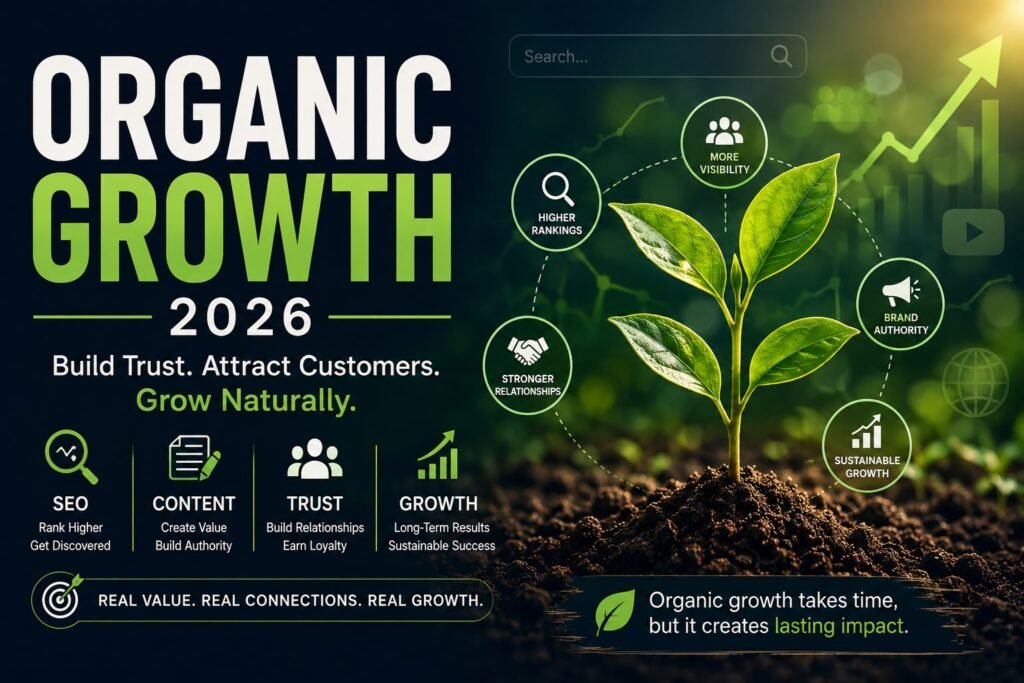
In today’s digital world, businesses have more ways than ever to reach potential customers. Paid advertising can generate immediate traffic, but sustainable growth requires something deeper: organic growth.
Organic growth means attracting customers without directly paying for every click, impression or visit. It can come through search engines, useful content, social media, referrals, email, communities and word-of-mouth.
In 2026, organic growth has become even more important because customers are becoming more selective about what they trust and where they spend their attention.
What Is Organic Growth?
Organic growth is the process of growing a business naturally through channels such as:
• Search Engine Optimization (SEO)
• Blog and content marketing
• Organic social media
• YouTube and video content
• Email newsletters
• Referrals and word-of-mouth
• Online communities
• User-generated content
• Answer Engine Optimization (AEO)
Unlike paid advertising, organic growth doesn’t require a business to pay for every individual visitor.
For example, if someone searches Google for “best digital marketing strategy for small businesses”, finds your blog through an unpaid search result and visits your website, that is organic traffic.
⸻
Why Organic Growth Matters in 2026
The digital landscape is changing rapidly. AI-powered search, social media and changing consumer behavior are making businesses rethink how they attract customers.
HubSpot’s 2026 research found that website/blog/SEO is the #1 ROI-generating marketing channel according to marketers, while blog posts remain among the top five highest-ROI content formats. Small businesses are also 23% more likely than average to report ROI from blog posts. 
This shows that building assets that continue working after publication can be extremely valuable.
⸻
- SEO Can Create Long-Term Visibility
One of the biggest advantages of organic growth is search visibility.
A well-optimized website can appear when potential customers are actively searching for information, products or services.
According to Ahrefs’ 2026 SEO statistics, 68% of online experiences begin with a search engine, while Google accounts for approximately 90.39% of global search-engine market share across devices. 
This makes search visibility extremely valuable for businesses.
However, modern SEO isn’t simply about inserting keywords into articles.
Today’s SEO involves:
Search Intent → Helpful Content → Technical SEO → Authority → User Experience → Continuous Optimization
⸻
- Content Becomes a Long-Term Business Asset
A social media post may receive attention for a few hours or days.
A useful article can continue attracting visitors months or even years after it is published.
For example, a business could publish an article such as:
“How to Choose the Right Digital Marketing Strategy for a Small Business”
If the article provides genuinely useful information and earns search visibility, it can continue bringing relevant visitors to the website.
That’s one of the biggest differences between organic and paid growth.
Paid marketing:
Spend → Traffic → Stop spending → Traffic can decline
Organic marketing:
Create → Optimize → Rank/Share → Continue attracting visitors
Organic growth generally takes longer, but the assets you build can continue producing value.
⸻
- AI Is Changing Organic Search — Not Eliminating It
One of the biggest changes in digital marketing is the rise of AI-powered search.
Google says AI Overviews now have more than 2.5 billion monthly active users, while AI Mode has surpassed 1 billion monthly active users. 
This means people are increasingly using AI-powered experiences to discover information.
For marketers, this creates a new opportunity: content needs to be useful enough to appear not only in traditional search results but also in AI-generated answers and citations.
HubSpot’s 2026 AEO research reports that 58% of marketers say their businesses are already optimizing content for answer engines, while 44% say they have made a business purchase based on brands discovered through answer engines. 
This is why modern organic growth increasingly includes SEO + AEO.
⸻
- Organic Social Media Builds Trust
Organic social media is another important part of sustainable growth.
Instead of constantly promoting products, brands can create content that educates, entertains and builds relationships.
Examples include:
• Educational Instagram Reels
• LinkedIn insights
• YouTube videos
• Industry tips
• Behind-the-scenes content
• Customer stories
• Case studies
• Short tutorials
HubSpot’s 2026 research identifies organic social media marketing as one of the most heavily leveraged marketing channels, alongside website/blog/SEO. 
The goal isn’t simply to collect followers.
The goal is to build attention → trust → authority → customers.
⸻
- Organic Growth Reduces Dependence on Paid Advertising
Paid advertising is powerful, but relying entirely on paid traffic can become expensive.
If advertising costs increase, businesses may need to spend more money just to maintain the same level of traffic.
Organic growth provides another source of visitors.
A healthy digital marketing strategy can therefore combine:
Paid Marketing + Organic Marketing
Paid campaigns can help generate immediate visibility, while organic channels can build long-term brand equity and discoverability.
They don’t have to compete with each other.
They can work together.
⸻
- Organic Growth Builds Brand Authority
People don’t always buy from the first company they discover.
They research.
They compare.
They read reviews.
They watch videos.
They search for answers.
They look at social media.
They ask AI tools.
A business that consistently publishes useful and trustworthy content can become an authority in its niche.
For example, a digital marketing professional could regularly publish content about:
• SEO
• Google Ads
• Meta Ads
• Performance marketing
• Analytics
• Content marketing
• AI marketing
• Conversion optimization
Over time, this creates a stronger digital footprint.
⸻
- Organic Growth Can Generate Better-Qualified Traffic
Not all website traffic is equally valuable.
A visitor who randomly sees an advertisement may not have strong purchase intent.
But someone searching:
“digital marketing consultant for small business”
already has a specific problem or requirement.
Organic search can therefore connect businesses with people who are actively looking for answers.
The important point is not simply getting more traffic.
It’s getting the right traffic.
⸻
- The Biggest Challenge: Organic Growth Takes Time
Organic marketing isn’t a shortcut.
SEO and content marketing often require months of consistent effort before meaningful results appear.
HubSpot’s 2026 organic marketing research notes that SEO is a slower strategy, with initial results often taking around 1–3 months, depending on the site and competition. 
And modern search is becoming more competitive.
Ahrefs reports that 96.55% of web pages receive no organic search traffic from Google. 
This is an important lesson:
Publishing content isn’t enough.
Businesses need to publish content that is:
• Useful
• Original
• Search-intent focused
• Well-structured
• Easy to understand
• Trustworthy
• Regularly updated
⸻
Organic Growth vs Paid Growth