
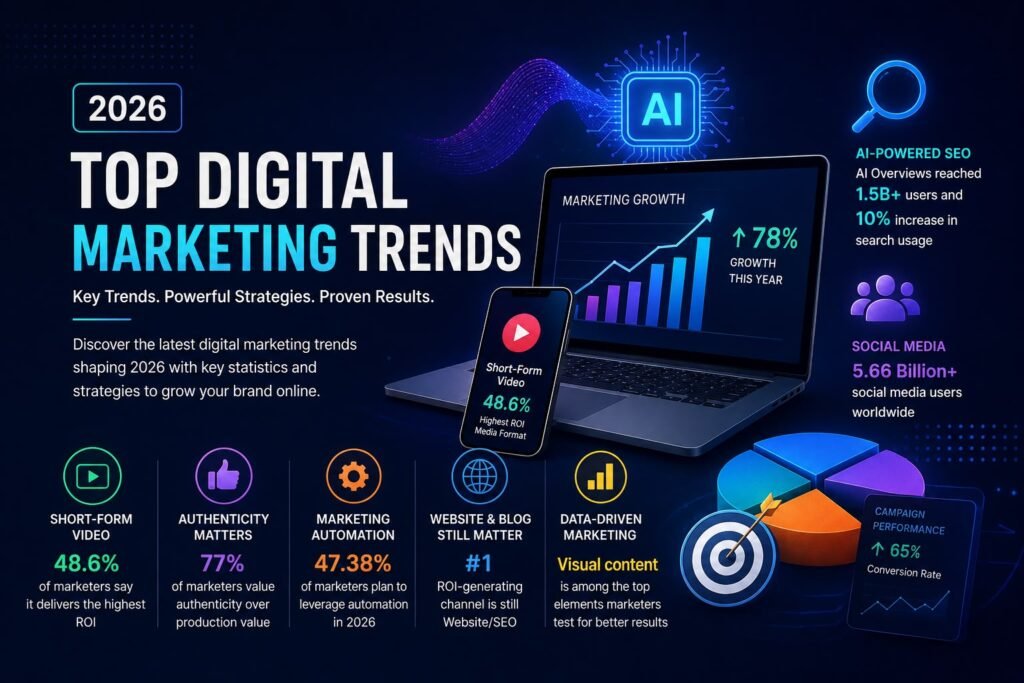
Digital marketing is changing faster than ever. Artificial intelligence, short-form video, social media, personalization, and data-driven advertising are transforming the way businesses reach and convert customers.
As we move through 2026, businesses can no longer rely only on traditional SEO or basic social media posting. Successful digital marketing now requires a combination of technology, creative content, customer data, and continuous campaign optimization.
Here are some of the top digital marketing trends in 2026, along with statistics that show why marketers should pay attention.
- Artificial Intelligence Is Transforming Digital Marketing
Artificial Intelligence has become one of the biggest changes in modern marketing.
Marketers are now using AI for content creation, audience research, campaign optimization, data analysis, brainstorming, customer support, and workflow automation.
Recent HubSpot data indicates that 64.5% of marketers say their organizations use AI moderately or extensively. Another HubSpot study found that nearly 75% of marketers use AI in their day-to-day work, while more than 68% of marketing leaders who invested in AI reported positive ROI. 
However, AI works best when combined with human strategy and creativity. Businesses should use AI to improve productivity and decision-making rather than simply publishing large amounts of automatically generated content.
- Short-Form Video Continues to Dominate
Instagram Reels, YouTube Shorts, and other short-form video formats have changed how people consume online content.
For marketers, short videos can quickly communicate a message, demonstrate a product, educate an audience, or introduce a brand.
According to HubSpot’s marketing research, short-form video is the highest-ROI content format, with roughly 30% of B2B and B2C marketers using it. 
The most effective short videos usually have three things in common: a strong opening hook, useful or entertaining content, and a clear call to action.
For brands in 2026, video should therefore be treated as an important part of the overall content strategy rather than an optional extra.
- Social Media Marketing Keeps Growing
Social media remains one of the biggest opportunities for businesses to connect directly with potential customers.
The scale is enormous.
DataReportal reported approximately 5.79 billion social media user identities worldwide at the start of April 2026, equivalent to about 69.9% of the global population. The figure had grown by around 294 million over the previous 12 months. 
This makes platforms such as Instagram, Facebook, YouTube, LinkedIn, and others important channels for brand awareness, lead generation, community building, and paid advertising.
Businesses should not necessarily try to dominate every social network. A better approach is to identify where their target customers spend their time and concentrate resources on those platforms.
- Data-Driven Performance Marketing Is Becoming More Important
Modern marketers have access to huge amounts of campaign data.
Instead of judging advertising only by likes, impressions, or clicks, businesses increasingly need to connect their marketing activities with measurable outcomes.
Important performance marketing metrics include:
• CTR – Click-Through Rate
• CPC – Cost Per Click
• CPA – Cost Per Acquisition
• Conversion Rate
• ROAS – Return on Ad Spend
• ROI – Return on Investment
The goal is simple: understand which campaigns, audiences, creatives, keywords, and landing pages actually produce business results.
This is why continuous optimization is becoming increasingly important. Marketers can analyze campaign performance, identify weaknesses, test new approaches, and allocate more budget toward what works.
- Personalization Is Becoming Essential
Customers increasingly expect brands to provide experiences relevant to their needs and interests.
Personalization can appear in email marketing, website content, product recommendations, advertisements, offers, and remarketing campaigns.
HubSpot’s marketing research found that 94% of marketers surveyed said offering a personalized customer experience impacts sales, while 86% said their customers receive a somewhat or very personalized experience from their brand. 
Good personalization is not simply inserting someone’s first name into an email. It involves understanding customer behavior and delivering the right message to the right audience at the right stage of their journey.
- SEO Is Evolving With AI-Powered Search
Search Engine Optimization is still important, but the way people discover information online is changing.
Users increasingly encounter AI-generated answers, richer search experiences, videos, social content, forums, and other formats alongside traditional search results.
For marketers, this means SEO should focus less on simply repeating keywords and more on producing content that genuinely answers a user’s question.
Successful SEO content should demonstrate expertise, answer specific search intent, have a clear structure, provide useful information, and offer a strong user experience.
Businesses should therefore think beyond simply “How do I rank for this keyword?”
A better question is:
“How can I create the best and most useful answer for someone searching for this topic?”
- Authentic Content and Micro-Influencers Are Growing
Consumers are exposed to advertisements constantly, which makes authentic recommendations increasingly valuable.
This is one reason businesses are working with smaller, niche creators rather than concentrating only on celebrities with millions of followers.
HubSpot reported that 24% of marketers used influencer marketing in 2024, with both B2B and B2C brands reporting particularly strong results from micro-influencers with roughly 10,000–100,000 followers. 
Smaller creators can offer highly relevant audiences and more natural communication, making them valuable for niche campaigns.
- Marketing Automation Is Saving Time
Automation allows marketers to perform repetitive tasks while focusing more time on strategy and creative work.
Businesses can automate parts of email marketing, lead nurturing, reporting, customer segmentation, remarketing, and campaign workflows.
AI is accelerating this trend further. HubSpot’s State of Marketing research lists workflow automation among major applications of AI in marketing. 
The objective, however, should not be to automate everything. Automation should remove repetitive work while keeping important customer interactions human and relevant.
The Future of Digital Marketing
Digital marketing in 2026 is becoming more AI-powered, visual, personalized, measurable, and performance-focused.
The businesses that succeed will not necessarily be those using the most tools. They will be the ones that understand their audience, create genuinely useful content, measure performance accurately, test continuously, and adapt quickly.
AI can accelerate marketing. Data can improve decisions. Automation can save time. But strong strategy and creativity remain essential.
For digital marketers, the key is simple:
Learn continuously. Test consistently. Measure results. Optimize what works.